
Llano County Sex Offender Checks
The Texas Public Sex Offender Registry is the main official search channel for Llano County. Texas Department of Public Safety maintains the central database, while local law enforcement authorities collect registrations and verify information. A county filter is useful for broad awareness. A name query is better when the search concerns a known person, and an address search helps with a specific part of Llano County. Results can change as a person moves, reports a new fact, or reaches a new registration status.
Start with enough detail to avoid mistaking one person for another. Compare aliases, age, physical traits, the listed address, registration authority, and reportable offense before drawing a conclusion. A public profile is a statutory notice, not a full court file or a complete criminal history. For the charging papers and judgment behind a case, use the appropriate clerk and the Llano County Court Case Lookup. The registry supplies the public registration facts that Texas law permits DPS to display.
Registry information can lag behind a reported move or correction. When the profile concerns an unincorporated Llano County address, call the Llano County Sheriff's Office. For an incorporated address, contact the applicable city police department. Do not assume that a sheriff is the registration authority for every address that has a Llano County mailing line.
Texas Public Sex Offender Registry Searches
DPS offers name and geographic routes through the Texas Public Sex Offender Registry. The search screen separates name search from address search, and it permits county, city, ZIP, address, radius, and map-based narrowing where the current interface exposes those controls. Live radius values were not verified, so use the values shown on the official portal rather than relying on a fixed distance quoted elsewhere.
A county search and an address search are not the same. The county field gathers entries tied to Llano County in the public data, while a street and radius search asks what appears near a location. A map view can help show spatial relationships, but its pin placement should not be read as a survey or proof of exact property boundaries. Open the full profile before acting on a result tile.
- Open the DPS registry and read the conditions governing access and lawful use.
- Choose name search for a known person or address search for a place. Select Llano in the county field for a countywide view.
- Review the results without relying on the name alone. Compare the photograph, aliases, age, description, address, and authority.
- Open the profile and read the offense, risk level, registration status, and verification details in context.
| Field Label | Type | Required | Notes |
|---|---|---|---|
| Name Search | Mode or tab | Mode-dependent | Switches the form to a personal-name query. |
| Last Name | Text | Mode-dependent | Primary surname field for a name search. |
| First / Middle Name | Text | Optional or unspecified | Helps distinguish people with similar surnames. |
| Address Search | Mode or tab | Mode-dependent | Starts a search tied to a place rather than a name. |
| Address / City / ZIP | Text or selection | Mode-dependent | Narrows results around the location supplied. |
| County | Dropdown | Optional | Select Llano for countywide registry results. |
| Radius | Dropdown | Optional | Use current live options; verified values were unavailable. |
| Map Search | Separate mode | No | Provides interactive geographic browsing. |
| Search / Clear | Buttons | Action | Runs the query or resets the entered criteria. |
The official DPS registry capture shows the search interface used for a Llano County sex offender lookup.
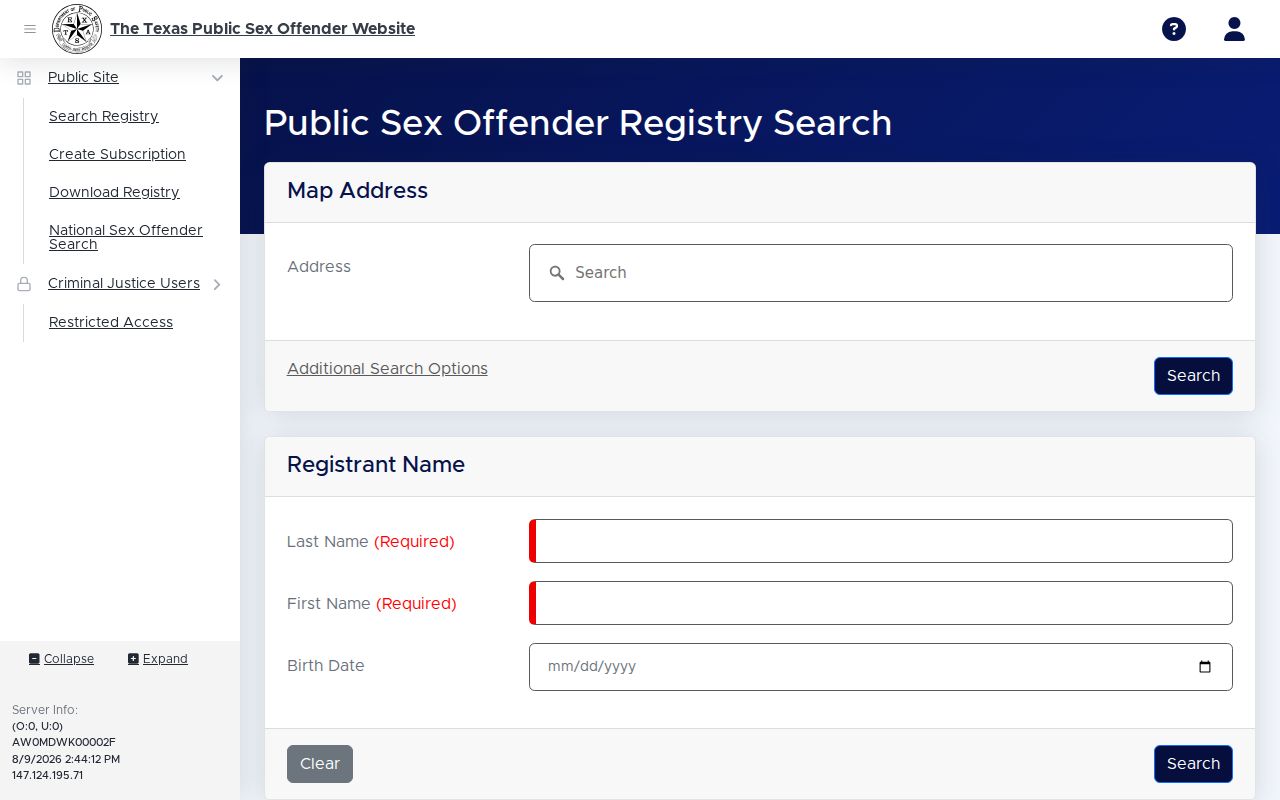
The form reinforces why the search method should match the task: names identify a person, while county and address fields support place-based safety awareness.
Registry Searches Beyond Llano County
A Llano County filter only shows the Texas entries returned for that county. It does not answer whether a person is registered in another state, territory, tribal jurisdiction, or the District of Columbia. The U.S. Department of Justice operates the National Sex Offender Public Website as a second official layer. NSOPW sends a query across participating public registries rather than replacing the Texas source.
The national search is most useful when a person has moved, an address sits near a county or state boundary, or the searcher does not know the current jurisdiction. Return to the Texas profile for Texas-specific details, risk language, and the local registration authority. The two portals can also refresh on different schedules. A difference is a reason to check the originating registry, not proof that either entry is false.
NSOPW displays what participating jurisdictions make public under their own laws. It does not create a uniform national profile or convert Texas risk levels into federal tiers. Search spelling, aliases, and geographic filters may also behave differently. Keep a note of which portal produced the record and when, then resolve a question through the jurisdiction that supplied it.
The Department of Justice's NSOPW capture demonstrates the cross-jurisdiction search layer assigned to Llano County registry research.
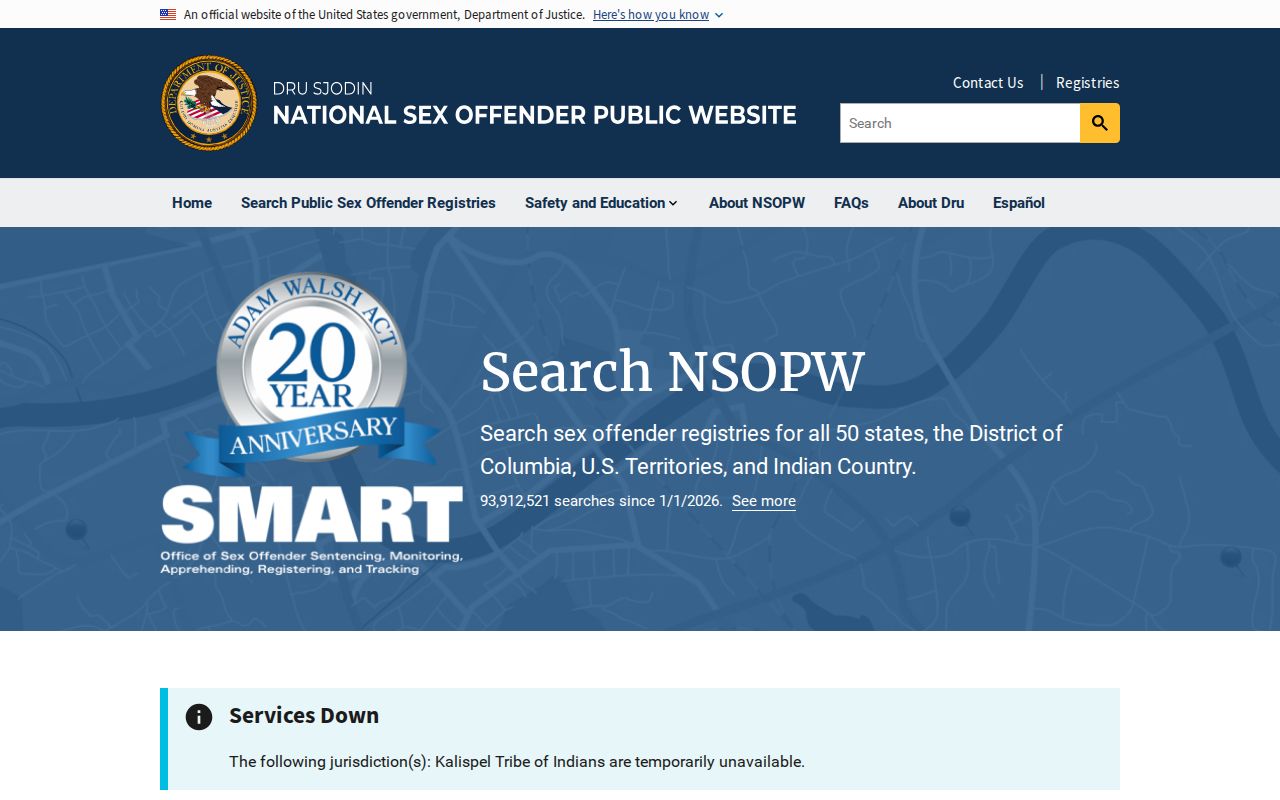
Using DPS and NSOPW together gives a broader view without treating a national index as the custodian of the underlying Texas record.
Registry Profiles: What They Show
A public Texas registry profile combines identification, location, offense, risk, and compliance information. It may include aliases and a color photograph, but a searcher should still compare several traits. The registered residence identifies the reported location, and the registration authority shows which local office maintains the entry. Offense text identifies the reportable basis. It does not reproduce every pleading, hearing, or fact found in the originating court case.
| Name & Aliases | Primary name and other reported names used to identify the registrant. |
|---|---|
| Photo & Description | Color photograph plus sex, race, age or birth information, and physical traits. |
| Registered Residence | Publicly releasable residence information and the responsible registration authority. |
| Offense & Disposition | Reportable offense, statute, jurisdiction, and conviction or adjudication basis. |
| Texas Risk Level | Level 1, 2, 3, or Civil Commitment designation, which is not a federal SORNA tier. |
| Other Public Fields | Registration status, vehicles when required, higher-education status where applicable, and displayed marks or tattoos. |
The profile should be read as of its displayed status and verification information. An old screenshot can miss a later move or update. Use the live DPS registry for current public data and ask the listed authority about a suspected reporting problem.
Some public profiles may also display vehicles when reporting is required, a higher-education connection where applicable, and visible scars, marks, or tattoos. Those details help distinguish people, but no single field should be used alone. The public registry can store less than the registration file itself, and the underlying court record may use different offense wording based on the charging instrument or judgment.
Hidden Llano County Registry Fields
Public access does not mean every item collected during registration appears online. Article 62.005 protects Social Security and driver's license numbers, personal phone numbers, online identifiers, employer details, victim identity, and certain other information requested by DPS. Juvenile information can also be nonpublic by court order. These limits protect identity, safety, and privacy while leaving the fields selected by law available for community awareness.
A missing employer, phone number, or online identifier is therefore not a sign of an incomplete search. It is part of the statutory design. Likewise, the absence of juvenile registration details from a public result does not prove no duty exists. Public visibility and a registration obligation are distinct questions. The local registration authority or DPS can address a compliance concern without disclosing protected data.
Victim information stays protected even when other facts are made public. Avoid guessing at a victim's identity from the offense, address, family relationships, or news reports. That restraint is part of lawful community use and prevents a registry search from causing fresh harm to a person whom Chapter 62 shields.
Visible is not complete: Texas intentionally withholds victim identity and sensitive personal identifiers even when a Llano County registry profile is public.
Registration Levels and Duties in Texas
Texas risk levels describe assessed danger, but they do not set a universal registration term. Level 1 means low danger and a lower likelihood of further criminal sexual conduct. Level 2 means moderate danger and possible continuation. Level 3 means serious danger and an expectation of continued conduct. Civil Commitment is a court designation for a sexually violent predator subject to a separate intensive supervision and treatment structure.
| Texas Designation | State Description | Duration and Verification |
|---|---|---|
| Level 1 / Low | Low danger; not likely to engage in criminal sexual conduct. | Offense rules set duration. General verification is annual unless another rule applies. |
| Level 2 / Moderate | Moderate danger; may continue criminal sexual conduct. | Risk number does not itself set the term. General verification is annual. |
| Level 3 / High | Serious danger; will continue criminal sexual conduct. | Duration follows the offense rule. Enhanced community notice applies. |
| Civil Commitment | Sexually violent predator designation with intensive supervision and treatment. | Annual at the center or every 30 days when living outside it. |
Adults generally register for life or until the tenth anniversary after the latest statutory release, supervision discharge, or deferred-adjudication trigger, depending on the offense. Juvenile adjudications generally extend to the tenth anniversary after disposition or completion, whichever is later. A juvenile transferred to district court uses a separate statutory trigger. Article 62.101 and the DPS program materials control the specific offense and term.
This is why “Level 1 means ten years” and “Level 3 always means life” are unreliable shortcuts. The risk assessment and the offense-based duration rule do different jobs. Read the Texas designation for danger and notice, then consult the applicable statutory offense rule for duration. A federal SORNA tier label cannot be substituted for either Texas analysis.
The date that starts a ten-year term can also be later than the conviction date. Texas measures from the latest trigger named in the statute, such as release from confinement, discharge from supervision, or dismissal and discharge from deferred adjudication. A profile viewed soon after judgment may therefore be far from the end of its registration period. Court documents help identify the disposition, while DPS and the registration authority maintain the operative registry status.
The DPS registration program overview provides the official explanation behind Llano County sex offender registration and notification.
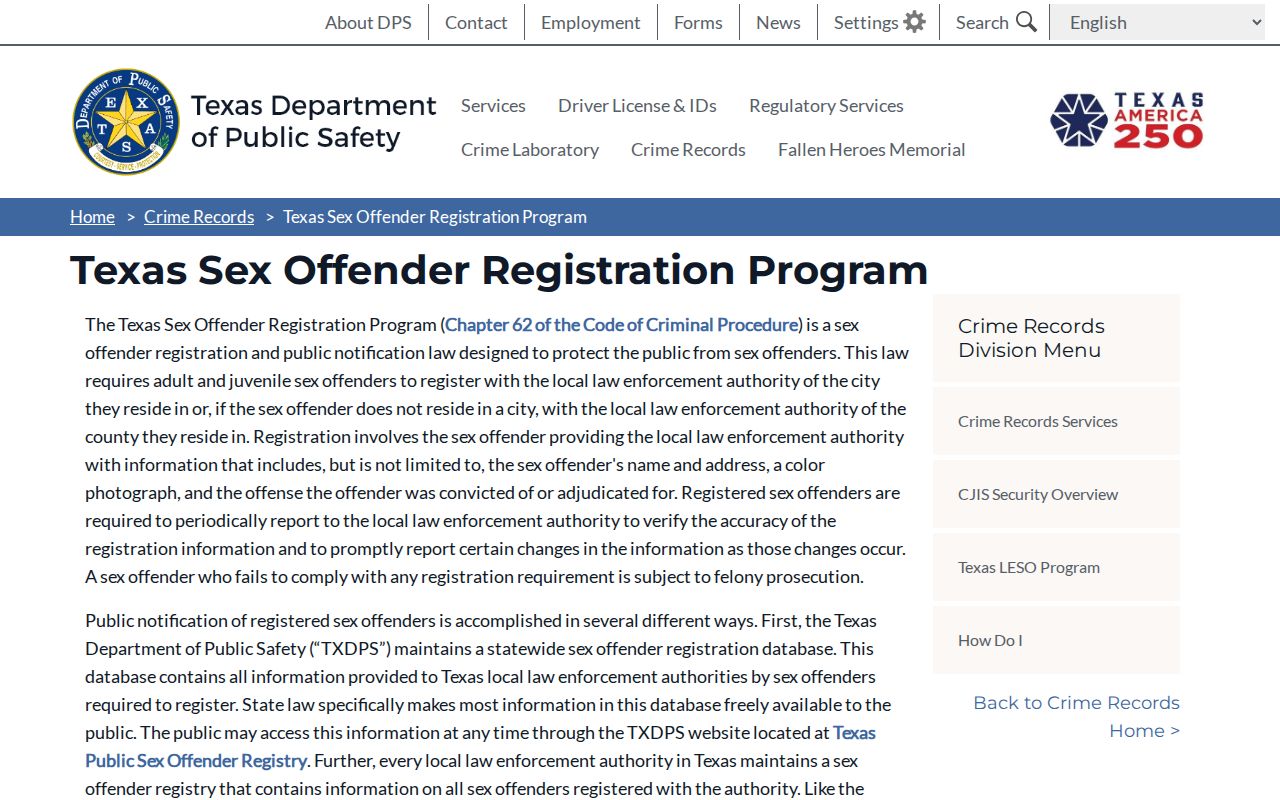
The program page is the better source for current Texas duties than a simplified federal tier chart, because Texas risk and duration rules are separate concepts.
Llano County Registry Verification
Verification frequency depends on the person's legal category. Under Article 62.058, a registrant with two or more sexually violent convictions or deferred orders, or one of each, must verify at least every 90 days. Other registrants generally verify once each year during the 30-day window before or after their birthday. Proof of identity and residence is required. Civilly committed people follow the center or community schedule shown above.
Some changes have their own deadline. A new or changed online identifier generally must be reported no later than seven days after it is established or changed, or on the first date permitted by local policy if that date is later. These are reporting duties, not a promise that every field becomes public. The responsible Llano County sheriff or city police authority collects the update, while DPS maintains the central public registry.
If an address seems stale, do not confront the listed person or household. Note the live profile, the address, the registration authority, and the reason for concern. Then report it to that authority. Call 911 only for an immediate threat. For an unincorporated Llano County address, the sheriff's number is 325-247-5767.
An apparent mismatch may have more than one cause. A move may still be within its reporting window, a local update may not yet be reflected on the public portal, the map point may be approximate, or the wrong person may have been selected from the result list. Report the concrete conflict and let the authority compare it with the nonpublic registration file. That approach is more accurate and far safer than posting an accusation.
Note: A profile's risk level, verification schedule, public fields, and registration duration answer different legal questions and should not be merged.
Llano County Registry Notifications
Texas uses added notice for certain Level 3 or civilly committed moves and releases. DPS supplies bilingual postcards for non-post-office-box addresses within one mile in an unsubdivided area or within three blocks in a subdivided area. That geographic distinction matters across Llano County, where rural land and compact city blocks can fall under different notice patterns.
Local authorities may also publish information, post or distribute notices, hold a public meeting, or maintain a local site. Schools receive notice in specified child-related circumstances. These methods supplement the public registry. They do not turn every registration event into a mailed notice, and they do not replace a current address search for household or neighborhood awareness.
A postcard radius describes the statutory notification zone, not a ban on movement or a measure of the risk at every home within that line. Llano County searchers should separate notification distance from registration duration, verification frequency, and any local rule. Each is a different part of the system.
For a rural Llano County location, the one-mile unsubdivided-area rule can cover a wide landscape with few addresses. In a platted city neighborhood, the three-block rule uses a different geographic frame. DPS prepares the bilingual postcard, and local authorities can add other notice methods authorized by law. Neither measure means that every nearby person receives the same facts through the same channel.
Community notification is meant to support sound safety choices. Keep the focus on the official facts, practical plans, and the correct authority. Public posting does not waive the privacy of victims or authorize surveillance, retaliation, or pressure against a registrant's family.
Using Registry Information Lawfully
Registry searches are for public safety awareness. They can help a Llano County resident understand a reported address, identify the responsible registration authority, and plan a calm response to a concern. The profile is not permission to confront, threaten, follow, expose private relatives, or interfere with lawful activity. A suspected failure to register should go to law enforcement, not to social media or a doorstep encounter.
Texas Code of Criminal Procedure Chapter 62 governs registry release and protects specified sensitive information. Use the DPS record as an official public notice, preserve the distinction between allegation and verified noncompliance, and let the proper agency investigate. Emergency danger belongs with 911. Nonurgent concerns belong with the registration authority shown on the profile.
When reporting suspected noncompliance, share the public profile and the specific fact that appears inconsistent. An exact address, observed move, or status mismatch is more useful than rumor. The receiving agency can compare the report with protected registration information that the public cannot see and decide whether investigation or correction is warranted.
Misuse is a crime: Texas Code of Criminal Procedure Chapter 62 forbids using registry information to injure, harass, or commit a criminal act against a registrant or another person. Report concerns to law enforcement and never confront the listed person.
The safest response is often the simplest: confirm the live record, identify the correct Llano County authority, and share only the facts needed to report the concern. That protects the public purpose of the registry while preserving the legal limits that surround it.